The Mint 400 is not just another desert race. First run in 1968, it has become one of the most recognizable names in American off-road racing, often described by organizers as the country’s oldest and most prestigious off-road race. What makes it unique is that it is not only a competition, but a full race-week spectacle: a vehicle parade down the Las Vegas Strip, a major off-road festival and tech inspection on Fremont Street, and then the race itself out in the Nevada desert. That combination of history, public attention, and brutal terrain is exactly why showing up matters.

For Unplugged Performance, arriving in Las Vegas was never about simply being seen. We came to the Mint 400 to participate in good faith, to test our work in one of the harshest environments in motorsport, and to see whether there is room for a different kind of off-road future. Events like this matter because they force ideas out of theory and into reality. You can talk all day about innovation, durability, or performance. The desert does not care. The desert tells the truth.
That truth started to come into focus the moment race week began. One of the first major public moments was the Mint 400 Vehicle Parade, the longest-running motorsports event on the Las Vegas Strip, where race vehicles roll through the city in front of fans before heading into the heart of the week’s festivities. Seeing our truck there, surrounded by the biggest names and most established machines in the sport, was surreal.
What stood out most, though, was the reaction.


Given how polarizing the Cybertruck can be, we expected skepticism, maybe even outright hostility. Instead, what we found was curiosity. People wanted to see it up close. They wanted to ask questions. They wanted to understand what we had built and why we had brought it to a race with this much heritage. That mattered to us. It reminded us that even in a tradition-rich motorsports space, people still respond to effort, intention, and the willingness to show up and try something different.
That feeling carried into one of the most significant moments of the trip, when our truck was lined up beside the only other EV Open Production entry in the field: the Chevrolet Performance and Hall Racing Silverado EV ZR2 driven by Gray Leadbetter. Official race listings showed just two entries in EV Open Production, and the class format required competitors to run two laps of the 95-mile Friday course to be classified for the win. This was not a concept exercise or a marketing display. In our class, the rule was simple: complete two laps, or you do not win.

That matchup gave the week a deeper meaning.
On one side was a major manufacturer-backed effort with Chevrolet Performance and Hall Racing. On the other was our team, pushing forward with belief, hustle, and a willingness to learn in public. And yet, the atmosphere around that moment was not hostile. It was respectful. Spending time around the GM side of the field, talking with engineers and seeing another team tackle the same question from a different angle, was one of the highlights of the trip. It did not feel like a feud. It felt like two different visions of the future arriving at the same proving ground.
Thursday brought tech and contingency, which at the Mint 400 is an event in itself. Fremont Street East becomes the center of the off-road world, with hundreds of exhibitors, race vehicles, fans, and builders all moving through the same public-facing environment before the race shifts to Primm. Every competitor goes through the festival route on the way to pre-race inspection, which makes tech inspection feel less like a back-lot procedure and more like a live demonstration of what this sport is all about.

Driving the Cybertruck through that environment was unforgettable.
Again, the truck felt like an alien object dropped into a legacy motorsports world. But again, the response surprised us. Not everyone loved it, and we never expected universal approval, but the overall reaction was far more open-minded than many people would assume. We saw genuine interest. We saw people trying to understand the build instead of dismissing it. We passed tech, earned our sticker, and took another step toward race day. More than that, we felt welcomed into a conversation we deeply respect.


After that, the mood shifted.
The rest of Thursday was spent in the kind of quiet, focused work that defines race prep. Back at the Silverton, our team moved into final-prep mode, checking systems, tightening details, and making sure every fastener and every subsystem was where it needed to be. There is nothing glamorous about those hours, but they are often the most honest. The crowds fade out. The cameras slow down. The work remains.
Friday morning came early. By around 5 a.m., the day was already in motion. By 6 a.m., we were meeting up and heading toward Primm, where the start-finish line marks the transition from preparation to consequence. That is the moment every race build eventually reaches. Planning ends. Opinions stop mattering. The course takes over.

And then, roughly 11 miles in, everything changed.
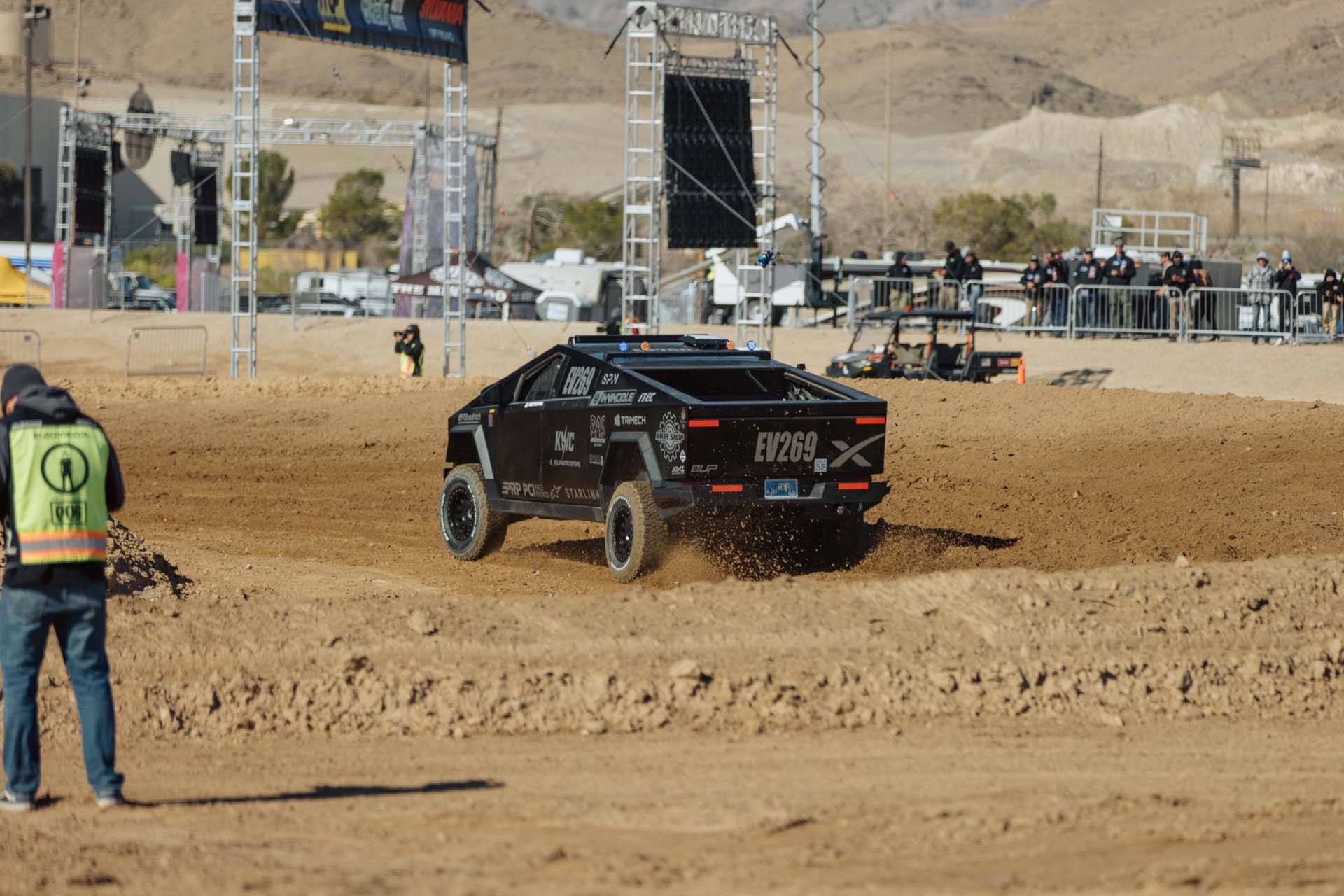
The truck suffered a major suspension failure involving the 2.5-inch lift kit. The spindle bolt connecting the upright and upper control arm snapped, which caused the upper control arm to collide with and destroy the air suspension components and wiring. In an instant, the day went from racing to survival.
What happened next, however, says just as much about the Mint 400 as anything that happened before the failure. AJ and Chewy went into full field-repair mode, using basic tools, ratchet straps, and zip ties to create a temporary fix and limp the truck back toward the pit for more service. It was gritty, imperfect, and completely real.


It was also a reminder that desert racing is not only about speed. It is about problem-solving under pressure, keeping composure when the plan falls apart, and doing everything you can with what you have.

That moment also clarified something bigger for us.
The Mint 400 is not important only because of who wins. It matters because it exposes every weakness, tests every assumption, and forces every team to answer the same hard question: what happens when things go wrong? That is where respect for this sport comes from. You do not earn it by showing up with a bold idea. You earn it by putting that idea in harm’s way and accepting the outcome.

That is why, despite the result on paper, this trip still felt meaningful.
We brought a Cybertruck to one of the biggest off-road races in America. We passed tech. We ran the parade. We stood alongside one of the only other EV efforts in the class. We earned real conversations with people who care deeply about this sport. We learned painful but valuable lessons. Most importantly, we came away with even more respect for the race, the desert, and the community that keeps this event alive year after year.
Across the parade, the festival, the inspection line, the pits, and race day itself, we felt something we will not forget: support. Some people were skeptical. Some were curious. Some were immediately excited. But many gave us a fair chance. They looked closely, asked thoughtful questions, and recognized the effort behind showing up. That support meant a lot.
We did not come to the Mint 400 to disrespect off-road culture or to pretend we had all the answers. We came because we believe innovation belongs in harsh environments too. We came because progress only happens when people are willing to test new ideas where failure is possible and lessons are expensive. We came because we respect this world enough to want to contribute to it, not criticize it from the outside.

This was not the ending we wanted.
But it is the beginning of something real.