Tesla Model S / Model S Plaid – UP-02 Forged Wheels (Set of 4)
-
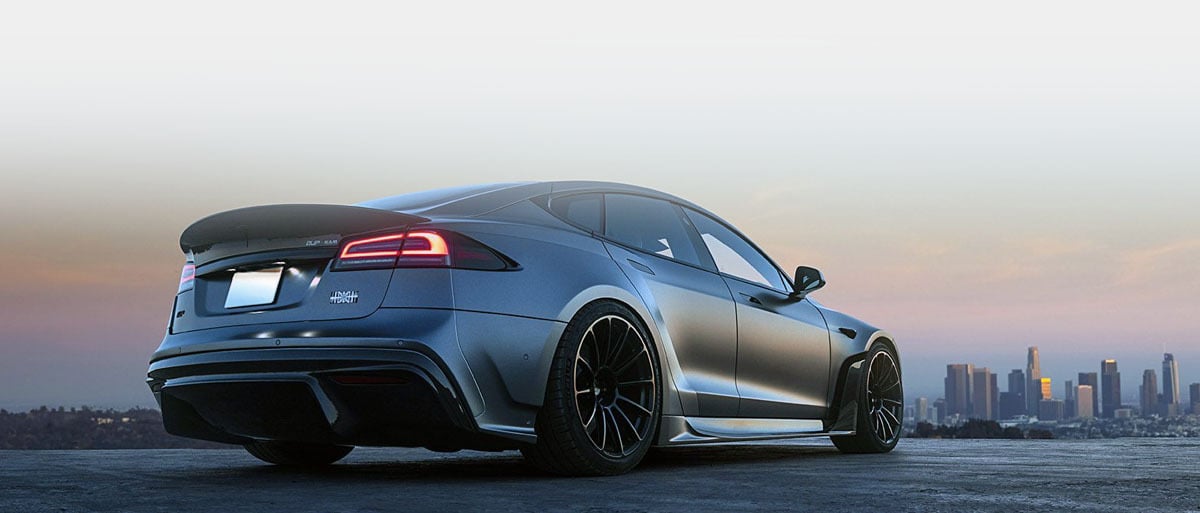
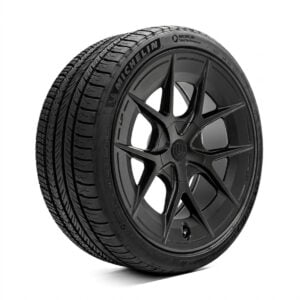
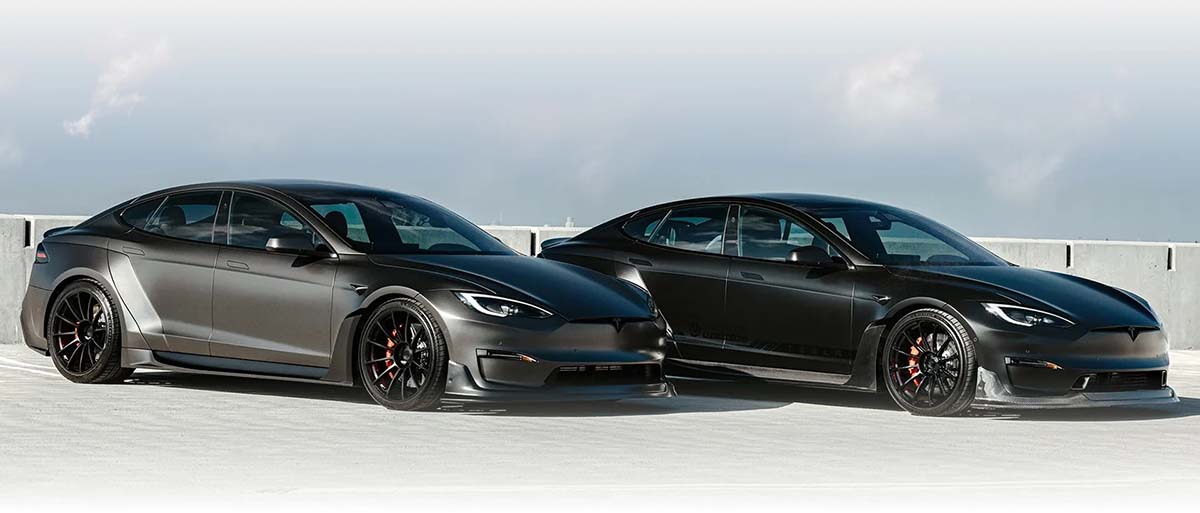
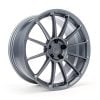
The UP-02, Unplugged Performance’s first forged wheel to market, blends Tesla’s iconic Uberturbine wheel with modern, angular aesthetics in a high-strength, light-weight twisted split 5-spoke wheel design for the Model S and Model S Plaid.
- Made of 6061-T forged billet aluminum
- Compatible with OEM Tesla center caps, lug nuts, and TPMS sensors
- Available in 19”, 20”, 21” sizes
- Fits your Tesla Model S / Model S Plaid 2021+
* Have OEM Tesla Track Pack Brakes? Contact our team for specific fitment advice before ordering.
Buy this product and earn 3895 UP Points.


Product Details
Innovation Meets Tradition
As the first forged wheel in our lineup, the UP-02 pays homage to Tesla’s iconic turbine wheel while pushing the boundaries of what is possible in Tesla wheel engineering. Designed to be a light and strong wheel, the UP-02 combines a revolutionary aesthetic with cutting-edge performance enhancements, making it the right wheel choice for Tesla owners who refuse to compromise.
Inspired by Tesla’s Legacy
The UP-02 draws inspiration from Tesla’s renowned uberturbine wheel, a design that reflected the forward thinking ethos Tesla embodied. Visually, the wheels featured a curved split 5-spoke design that radiates outward in a twisted, turbine-like pattern, giving the impression of motion even when the vehicle is stationary. With that design in mind, our design team wanted to keep the same curve-like turbine pattern to create a wheel that surpasses its predecessor in both form and function. The result is a wheel that captures the essence of Tesla’s design DNA while delivering modern performance benefits that continue to push the Model S forward.
Distinctive Twisted Profile
One of the most striking features of the UP-02 is its twisted split 5-spoke design, a visual tribute to the Tesla turbine wheel. This unique styling is not just for a look, it also translates to a functional purpose. By minimizing the amount of spokes, we are able to shave off unnecessary material that results in weight savings for the performance benefit of your Model S. With fewer spokes, we also have an improvement in acceleration, brake performance aligning perfectly with Tesla’s sustainability goals.
Forged for Unmatched Strength
The UP-02 is meant to be tough as s*@t. Many aftermarket wheels are produced in a casting process that nets a heavy and weaker wheel making it range-inefficient and often times prone to cracking and bending making that inexpensive wheel even more expensive in the long run. UP-02 wheels, like all UP Forged wheels, are manufactured using the forging process, meaning the wheels are milled from a single solid piece of aluminum resulting in an extremely strong and lightweight wheel designed to exceed all standards. If you’re shopping for new wheels, trust that our UP-02 forged wheels will effortlessly handle the high torque and power output of your Model S in all applications, street, spirited and even track driving. Machined from custom high clearance 6061 forged billet aluminum, this wheel will prove to be a reliable foundation to build on as you continue your Tesla modification journey.
Customizable Finishes
UP-02 is available in a range of finishes including Satin Black, Satin Bronze, Gloss Black, Satin Titanium and Satin Bronze. We also offer custom finishes to get the exact look you’re trying to achieve for your Tesla. If you’re interested in a custom finish, contact us at info@unpluggedperformance.com
Need help?
Find an installer
Wheel Fitment Info
| Wheel Fitment | Offset | Load Rating | Application | OEM Tire Acceptable | Recommended Tire Size |
|---|---|---|---|---|---|
|
19×9.5/10.5 |
+35 |
1984 lbs (900 kg) |
OEM+ / Sport |
Fits OEM Tires |
255/45 19 / 285/40 19 |
|
19×10.5 |
+35 |
1984 lbs (900 kg) |
Sport Performance |
No |
285/40 19 |
|
20×9.5/10.5 |
+35 |
1984 lbs (900 kg) |
OEM+ / Sport |
No |
265/40 20 / 295/35 20 |
|
20×10.5 |
+35 |
1984 lbs (900 kg) |
Sport Performance |
No |
295/35 20 |
|
21×9.5/10.5 |
+35 |
1984 lbs (900 kg) |
OEM+ / Sport |
Fits OEM Tires |
265/35 21 / 295/30 21 |
|
21×10.5 |
+35 |
1984 lbs (900 kg) |
Sport Performance |
No |
295/30 21 |

Why does my Tesla show a TPMS fault when parked near other wheels?
If your Tesla displays a Tire Pressure Monitoring System (TPMS) fault or error it may be because you are parked nearby or passing by a second set of wheels (such as winter tires or track wheels stored in your garage), it is likely caused by signal interference. Your car’s receiver is detecting the sensor signals from the stored wheels and “confusing” them with the sensors currently installed on the vehicle.
This “crosstalk” prevents the system from locking onto the active tires. The issue typically resolves itself once the vehicle drives away from the stored wheels.
Why It Happens
- Signal Overlap (Bluetooth/RF Interference): Newer Teslas (Model 3, Model Y, Cybertruck, and refreshed S/X) use Bluetooth Low Energy (BLE) sensors, while older models use 433 MHz radio frequencies. When stored wheels are within range, the car receives data from up to eight sensors simultaneously. The system struggles to distinguish which sensors are actually on the car.
- Sensor ID Confusion: Every TPMS sensor has a unique ID. If your Tesla previously “learned” the sensors on your stored wheels, it may attempt to connect to them instead of the currently installed set, triggering a “System Fault” alert.
- Interrupted “Relearn” Process: Tesla TPMS systems auto-relearn while driving. If you recently swapped wheels and parked near the old set before driving long enough, the car may fail to finalize the new sensor IDs.
How to Fix It
- Move the Extra Wheels: The most effective fix is to increase the distance between your Tesla and the stored wheels. Moving them to a different corner of the garage, a shed, or a basement usually breaks the signal interference.
- Drive the Vehicle: Drive your Tesla for at least 10–15 minutes above 15 mph (25 km/h). This forces the system to poll the sensors. The car will recognize the moving sensors attached to the wheels and ignore the stationary sensors left in the garage.
- Force a Reset: If driving doesn’t clear the error, follow the model-specific guides below to force the system to reset.
Model-Specific TPMS Reset Guides
Tesla Model 3 & Model Y
These models do not have a dedicated “Reset” button; they use an auto-learn system. If the system is stuck, you can force a reboot of the TPMS ECU by changing the wheel configuration.
- Drive: Drive for 10 minutes at over 15 mph (25 km/h).
- Force Reset (if driving fails):
- Park the vehicle.
- Go to Controls > Service > Wheel & Tire Configuration.
- Change the wheel size to a different size (e.g., from 19″ to 20″) and confirm.
- Wait for the system to reboot (screen may flash).
- Change the size back to your correct wheel size.
- Drive again to allow the system to relearn the correct sensors.
Tesla Model S & Model X (Refresh 2021+)
The “Refresh” models (Plaid/Long Range) use the same Bluetooth (BLE) system as the Model 3/Y.
- Drive: Drive for 10 minutes at over 15 mph (25 km/h).
- Force Reset:
- Go to Controls > Service > Wheel & Tire Configuration.
- Update the configuration to a different wheel set, wait for the reset, and then switch it back to the correct set.
- The car will now listen for new sensors during your next drive.
Tesla Model S & Model X (Legacy 2012–2020)
Older models use 433 MHz RF sensors and often have a manual reset option in the menu.
- Menu Reset:
- Go to Controls > Service > Reset TPMS Sensors.
- Select the correct wheel size if prompted.
- Tap Reset.
- Drive: Immediately drive the vehicle above 25 mph for at least 10 minutes to complete the calibration.
Tesla Cybertruck
The Cybertruck uses high-bandwidth Bluetooth sensors and a newer interface.
- Auto-Learn: The Cybertruck is designed to auto-detect wheel changes quickly. Drive for roughly 5–10 minutes on a clear road.
- Manual Check:
- Go to Controls > Service > Wheel & Tire.
- Ensure the correct wheel type (e.g., 20″ Core vs. 35″ All-Terrain) is selected.
- If the error persists, toggle the wheel selection to a different option and then back to the correct one to force the system to restart its search protocol.
What are the advantages of titanium lug nuts for my Tesla?
Significant Weight Reduction
- Unplugged Performance’s titanium lug nuts save about 46% in weight compared to OEM steel nuts, thanks to their 64‑grade titanium construction.
- Lowering unsprung and rotational weight enhances steering feel, acceleration, braking, and overall suspension responsiveness.
Exceptional Corrosion Resistance & Longevity
- Titanium naturally forms a protective oxide layer, making it virtually impervious to rust—even in salty or coastal environments where steel would degrade.
- Users consistently praise titanium for retaining both form and function over time, especially compared to more oxidizing metals.
Superior Strength & Durability
- Aerospace-grade titanium such as Grade 5 (6‑4) offers a remarkably high strength-to-weight ratio, making the lug nuts both light and formidable.
- Titanium retains its mechanical properties under high heat, important for lug nuts that are close to hot brakes and subject to thermal stress.
Sleek Aesthetics & Custom Finishes
- Eye-catching finishes like burnt titanium (blue-purple-gold hues) or sleek black DLC coating, providing both style and surface protection
- In general, titanium lug nuts elevate the visual appeal of wheels with a high-end, sophisticated look
Long-Term Value and Peace of Mind
- While pricier upfront, titanium lug nuts offer long-term cost benefits due to their durability, less replacement needed, and better resale value if maintained
- They’re reliable, low-maintenance, and inspire confidence, especially if you’re performance-driven or want lasting quality
What are wheel spacers? Do I need them?
Wheel spacers are metal rings that are installed between a vehicle’s wheel and the wheel hub (or the mounting surface of the wheel). Their primary function is to increase the distance (or offset) between the wheel and the vehicle’s suspension or fender. Wheel spacers are typically used to achieve a desired stance, improve wheel clearance, or adjust the offset of the wheel for better fitment.
Key Functions of Wheel Spacers:
- Improve Wheel Fitment:
- Wheel spacers allow a vehicle to run wider or more aggressive wheels that would not otherwise fit without rubbing against the suspension components, fenders, or brakes. By pushing the wheels outward, spacers help achieve the desired stance and prevent interference with the vehicle’s body.
- Enhance Aesthetic Appearance:
- Many car enthusiasts use wheel spacers to create a more visually appealing stance. Spacers can give the vehicle a wider stance, making it look more aggressive or balanced, which is especially common in performance, off-road, or custom vehicles.
- Increase Track Width:
- Wheel spacers increase the track width (the distance between the left and right wheels). A wider track improves vehicle stability, handling, and cornering ability, especially at high speeds or during aggressive driving. This is a common modification for sports cars or vehicles that participate in racing.
- Correct Wheel Offset:
- If a vehicle’s wheels are too tucked in or too far out (due to factory design or aftermarket modifications), wheel spacers can be used to adjust the wheel offset. They help to position the wheels more centrally within the wheel wells or achieve a more desirable offset.
- Prevent Rubbing:
- In some cases, after lowering a car or adding a suspension modification, the tires might rub against the inner fenders or suspension components. Using a wheel spacer can provide extra clearance to prevent this rubbing and protect the tires and suspension parts.
What is a forged wheel? Are they better than OEM Telsa Wheels?
A forged wheel is a type of wheel made from a solid piece of metal (usually aluminum or magnesium) that is shaped using a high-pressure forging process. The process involves applying extreme heat and pressure to the metal, which results in a wheel that is both strong and lightweight. This is different from a cast wheel, which is made by pouring molten metal into a mold and allowing it to solidify.
How Forged Wheels are Made:
- Billet Material: A solid block of metal, often referred to as a billet, is heated to a high temperature.
- Forging Process: The heated billet is then placed into a die and shaped using high-pressure machinery or a hydraulic press. The metal is compressed and shaped into the desired wheel form.
- Heat Treatment & Finishing: After the forging process, the wheel is heat-treated for additional strength, and it is then machined, polished, and finished to its final appearance.
Advantages of Forged Wheels Over Cast Wheels:
Stronger and More Durable:
- Forged wheels are stronger because the forging process aligns the metal’s grain structure, making it more resistant to cracking or breaking under pressure. This results in a wheel that is better equipped to handle stress, impacts, and high-performance conditions.
- Cast wheels, on the other hand, have a less uniform grain structure due to the molding process, making them more prone to cracks and failure under heavy loads or stress.
Lighter Weight:
- Forged wheels are typically lighter than cast wheels of the same size because they can be made with less material while still maintaining strength. The forging process allows for more precise design, and excess material can be removed in areas where it’s not needed, resulting in a lighter wheel.
- Cast wheels are usually heavier, as the mold often requires more material and is less efficient in terms of weight-saving design.
Improved Performance:
- Because of their strength-to-weight ratio, forged wheels offer better handling, acceleration, and braking performance. The lighter weight reduces rotational mass, which means less energy is required to move the wheel, improving overall performance.
- Cast wheels may not offer the same performance benefits, as their extra weight can reduce acceleration and braking efficiency.
Better Impact Resistance:
- Forged wheels are better at withstanding impacts from potholes or rough terrain due to their superior strength. This makes them ideal for high-performance and off-road vehicles where rugged conditions are common.
- Cast wheels are more likely to crack or bend under such impacts, which makes them less suitable for extreme driving conditions.
Longer Lifespan:
- Forged wheels generally have a longer lifespan because they are more durable and resistant to wear, corrosion, and damage from impacts.
- Cast wheels tend to wear down faster and may require more frequent replacements, especially under harsh driving conditions.
Do I need conical or ball seat lug nuts?
OEM Tesla Lug Nuts and UP Titanium and Aluminum Lugs share identical conical designs to maximize contact between lug nuts and wheels. Other aftermarket lug nuts have a generic conical shape and very little surface area contact between nut and wheel which is potentially dangerous.
Can I reuse my OEM TPMS?
Yes, all UP Forged Wheels are designed to fit Tesla OEM TPMS.
What is the difference between staggered and square wheel setups?
Staggered Setup: Involves different wheel sizes on the front and rear axles, typically with a wider wheel in the rear. This is often used for performance or aesthetic purposes.
Square Setup: Uses the same wheel size on all four corners, which allows for tire rotations.
Do UP Forged Wheels come with a warranty?
Yes, all UP Forged Wheels come with a warranty. Please visit our Terms and Conditions page for details.
Do I need to get an alignment after installing aftermarket wheels?
Although it is not necessary, unless suspension modifications are also being installed at the same time, it’s often recommended to get a alignment after installing new wheels, especially if the size, offset, or width of the wheels significantly differs from stock specifications. This helps prevent uneven tire wear and ensures that the vehicle handles properly.
Can UP Forged wheels affect my car’s performance?
Yes, wheels can impact performance in various ways. Lighter wheels can improve acceleration, braking and range, while heavier wheels can have the opposite effect. Additionally, wider wheels can enhance traction but may affect ride quality and handling, depending on the setup especially when stepping up to a larger diameter wheel and a tire with a smaller height sidewall.
How do I know what size wheel will fit my car?
Wheel size is determined by three key measurements: diameter (in inches), width (in inches), and bolt pattern (the number of holes and the distance between them). Additionally, the wheel’s offset and backspacing play a role in fitment. It’s important to check your car’s specifications and use our fitment guide to determine the correct size for your vehicle.